
Ryan Eisenhuth | February 19, 2026
Have you ever witnessed a presentation in which the presenter clearly knew what they were talking about, but their PowerPoint was riddled with typos and distracting transitions?
Have you ever collaborated with a fellow student who excels academically, but consistently shows up late to group meetings and takes weeks to answer emails?
Or have you ever sat beside someone who clearly understands complex readings, but rarely speaks in class – or worse – dominates the discussion and interrupts your peers?
Examples like these illustrate the difference between competence and professionalism as they exist in the life of a typical graduate student. In other words, as Ryan Sharma (2020) notes, the quality of your work (competence) and the quality of your interpersonal conduct and attitude (professionalism) are two distinct skill sets.
As a graduate student, your classes are designed to help you build your competence as a scholar by inviting you to read and reflect on foundational texts, evaluate competing theories, and use various research methods to make unique contributions to your field.
But this competence alone won’t carry you through your career.
You are expected not only to be competent in your field but also to act as a dependable, respectful, attentive, trustworthy, and confident professional.
Even so, training in professional development is lacking in a typical graduate program-of-study. While you may decipher a series of mini-lessons by observing others, interpreting feedback, navigating awkward missteps, and piecing together advice from mentors, the rules of professionalism tend to go unspoken and unwritten, leading to the topic of this blog, the “hidden curriculum.”
The Hidden Curriculum
At the Ohio Communication Association’s 88th Annual Conference in 2024, Dr. Lisa K. Hanasono of Bowling Green State University delivered a compelling keynote address on the hidden curriculum of higher education.
According to Hanasono (2024), the hidden curriculum consists of “the informal expectations and practices, unwritten rules, and underlying power dynamics that inequitably shape, constrain, and facilitate individuals’ educational journeys and academic careers.”
Examples of the hidden curriculum include:
- the “alphabet soup” of academic abbreviations (TA, RA, GA, IRB, NCA, ICA, APA);
- understanding institutional types (R1 universities, liberal arts colleges, community colleges);
- navigating disciplinary hierarchies and epistemological divides;
- knowing norms of participation, networking, presentation, and publication;
- mastering style guides such as The Publication Manual of the American Psychological Association, The MLA Handbook, and The Chicago Manual of Style;
- and managing time, boundaries, and professional commitments effectively.
In short, the hidden curriculum includes everything you are expected to absorb outside of your syllabi and program handbooks.
Revealing the Hidden Curriculum
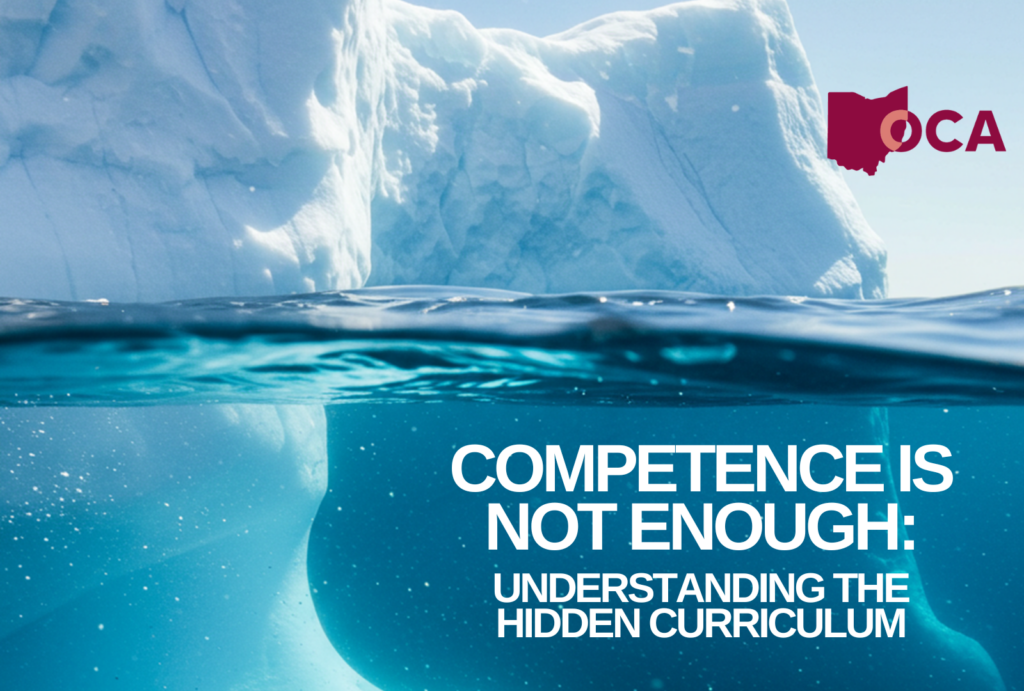
Like the submerged portion of an iceberg, the hidden curriculum is powerful precisely because it is invisible. Its norms are so deeply ingrained in academic culture that they often go unquestioned.
Yet these unspoken expectations shape opportunities, evaluations, and advancement for all scholars.
While everyone must navigate this terrain, its effects are not distributed equally. International students, first-generation college students, and those without prior exposure to academic culture often experience the hidden curriculum most acutely. What feels intuitive to some may feel opaque and exclusionary to others.
Sadly, “while much has been written about academia’s hidden curriculum,” Gabriela Garcia (2026) observes, “little has been done to address it systematically with graduate students,” giving us an exigency – a gap that ought to be filled in ongoing disciplinary conversations.
Thus, to better facilitate the academic and professional development of communication scholars in the state of Ohio and beyond, the Ohio Communication Association is launching a series of blog posts on revealing the intricacies of the hidden curriculum.
Aimed primarily toward current graduate students and undergraduate students considering graduate school, “Revealing the Hidden Curriculum” will amplify the voices of OCA members who have navigated – and learned from – the complexities of academic life.
Posted monthly, each contributor will address the question of “what do you know now that you wish you knew at the beginning of graduate school?”
In doing so, we will explore an array of topics, including making the most out of academic conferences, determining if your article is ready for submission to a scholarly journal, grappling with imposter syndrome in applied communication work, establishing your brand as an intellectual, finishing your thesis or dissertation on time, and more.
Our hope is that “Revealing the Hidden Curriculum” will foster meaningful conversations about the taken-for-granted realities of our discipline and serve as a practical, enduring resource for emerging scholars.
Let us begin.
References
Garcia, G. (2026, Feb. 17). What grad students need: A crash course in institutional literacy. Inside Higher Ed. https://www.insidehighered.com/opinion/career-advice/2026/02/17/what-grad-students-need-institutional-literacy-opinion.
Hanasono, L. K. (2024, Oct. 4-5). Revealing and communicating the hidden curriculum of higher education [Keynote address]. Ohio Communication Association’s 88th Annual Conference, Cleveland State University, Cleveland, OH, United States.
Sharma, R. (2020). The unwritten rules of professional etiquette: Building a positive reputation in graduate school. Habile Press.
Ryan Eisenhuth (B.A., Geneva College) currently serves as the Communication Coordinator for the OCA. Ryan is a doctoral student in the School of Communication Studies at Ohio University, where he teaches public speaking, argumentation & advocacy, interviewing techniques, and communication & new technology. Most of his research lies at the intersection of rhetorical theory, media ecology, and religious communication.